Pages

Thursday, July 29, 2010

Parvovirus and Puppies

I have been a dog owner my entire life. We go to the vet for their annual shots and I always look over their vaccination records, but until recently did I take note of the parvovirus vaccination.


A good friend of mine had been tossing around the idea of adding another dog to their family. I was sent a photo of the cutest Toy Australian Shepherd I had ever seen that was staying at my local barn. Well, I scooped him up immediately and brought him my office to show my friend. He was perfect! And, I believe it was love at first sight on both of their parts! He was named immediately... Stonewall Jefferson Fisher aka "SJ".

 STONEWALL JEFFERSON FISHER 


"SJ" just hung out all day, he slept mostly, but he was in a new place and we thought he just getting acclimated. He seemed to be sad also...  possibly missing his litter mates. 

Little did we know at the time, but "SJ", was showing symptons of the Parvovirus. Later that evening he begin having severe diarrhea and vomiting. He was rushed down to the 24 hour animal emergency clinic, but it was too late. "SJ" was diagnosed with the "Parvovirus" and due to his size and age, he was unfortunately unable to recover.

It was a sad day for all of us. If you believe everything happens for a reason, what could the reason be for this? 

The best that I can come up with, is we were meant to become more educated about the Parvovirus and to spread the word to others. Parvovirus is more than just a word on your pet's vaccination records. 

It is currently the most common infectious disorder of dogs in the United States. 


Parvo can live up to 6 months or so in your home or yard. And if you and/or your home has been exposed to a dog with Parvo, you need to wait the 6 months to avoid the risk of it spreading. You can have a veterinarian draw blood and run a titre to find out how well your new puppy will fare in a parv-infected environment. Adult dogs generally have a higher resistance than puppies do, but they need to be kept current on their vaccines. If in doubt, have your vet do the titre.

There is a ton of information on the internet regarding this virus. Please take a moment to review the below information that I found on PetEducation.com:
How is parvovirus spread?
Parvovirus is spread through contact with feces containing the virus. The virus is known to survive on inanimate objects - such as clothing, food pans, and cage floors - for 5 months and longer in the right conditions. Insects and rodents may also serve as vectors playing an important role in the transmission of the disease. This means any fecal material or vomit needs to be removed with a detergent before the bleach solution is used. The bleach solution should be used on bedding, dishes, kennel floors and other impervious materials that may be contaminated.


The normal incubation period (time from exposure to the virus to the time when signs of disease appear) is from 7-14 days. Virus can be found in the feces several days before clinical signs of disease appear, and may last for one to two weeks after the onset of the disease.


What are the symptoms of parvovirus infection?
There is a broad range in the severity of symptoms shown by dogs that are infected with parvovirus. Many adult dogs exposed to the virus show very few, if any, symptoms. The majority of cases of disease are seen in dogs less than 6 months of age with the most severe cases seen in puppies younger than 12 weeks of age. There are also significant differences in response to parvovirus infections and vaccines among different breeds of dogs, with Rottweilers, Doberman Pinschers, and Labrador Retrievers being more susceptible than other breeds.
The most common form of the disease is the intestinal form known as enteritis. Parvovirus enteritis is characterized by vomiting (often severe), diarrhea, dehydration, dark or bloody feces, and in severe cases, fever and lowered white blood cell counts. Acute parvovirus enteritis can be seen in dogs of any breed, sex, or age. The disease will progress very rapidly and death can occur as early as two days after the onset of the disease. The presence of gram negative bacteria, parasites, or other viruses can worsen the severity of the disease and slow recovery. A less common form of the disease causes myocarditis (inflammation of the heart).


How is parvovirus infection diagnosed?
Not all cases of bloody diarrhea with or without vomiting are caused by parvovirus and many sick puppies are misdiagnosed as having 'parvo.' The only way to know if a dog has parvovirus is through a positive diagnostic test. In addition to the more time consuming and expensive traditional testing of the blood for titers, a simpler test of the feces with an enzyme-linked immunosorbent assay antigen test (ELISA), commonly called the CITE test, is also available through most veterinary clinics. Testing of all suspect cases of parvo is the only way to correctly diagnose and treat this disease. A complete physical exam and additional laboratory tests such as a CBC and chemistry panel help to determine the severity of the disease.


How is parvovirus disease treated?
The treatment of parvovirus is fairly straightforward and directed at supportive therapy. Replacing fluids lost through vomiting and diarrhea is probably the single most important treatment.Intravenous administration of a balanced electrolyte solution is preferred, but in less severe cases, subcutaneous or oral fluids may be used. In severe cases, blood transfusions may be necessary. Antibiotic therapy is usually given to help control secondary bacterial infections. In those dogs who have severe symptoms, antiserum against endotoxins may be given. Corticosteroids may be given if the animal is in shock. In cases of severe vomiting, drugs to slow the vomiting may also be used. After the intestinal symptoms begin to subside, a broad spectrum de-worming agent is often used. Restricting the food during periods of vomiting is also necessary and parenternal nutrition (providing nutrients intravenously) may be necessary.


Undertaking the treatment of affected dogs and puppies without professional veterinary care is very difficult. Even with the best available care, the mortality of severely infected animals is high. Without the correct amount of properly balanced intravenous fluids, the chance of recovery in a severely stricken animal is very small.


All parvoviruses are extremely stable and are resistant to adverse environmental influences such as low pH and high heat. Exposure to ultraviolet light and sodium hypochlorite (a 1:32 dilution of household bleach - ½ cup bleach to 1 gallon of water) can inactivate parvovirus. The bleach solution can be impaired by organic matter and needs to have adequate exposure time and proper concentrations to work effectively.


Immunity and vaccination
If a puppy recovers from parvovirus infection, he is immune to reinfection for probably at least twenty months and possibly for life. In addition, after recovery the virus is not shed in the feces. There are many commercially prepared attenuated (modified) live CPV-2 vaccines available. The current vaccines protect against all strains of the canine parvovirus, including the relatively new parvovirus-2c strain. Although some people have expressed concern about the possibility of modified live vaccines reverting to a virulent strain after being given and then causing disease, studies have repeatedly shown that this does not occur. Commercially prepared vaccines are safe and do not cause disease.


The primary cause of failure of canine parvovirus vaccines is an interfering level of maternal antibody against the parvovirus.

The primary cause of failure of canine parvovirus vaccines is an interfering level of maternal antibody against the canine parvovirus. Maternal antibodies are the antibodies present in the mother's milk during the first 24 hours after the puppy's birth. The age at which puppies can effectively be immunized is proportional to the titer of the mother and the effectiveness of transfer of maternal antibody within those first 24 hours. High levels of maternal antibodies present in the puppies' bloodstream will block the effectiveness of a vaccine. When the maternal antibodies drop to a low enough level in the puppy, immunization by a commercial vaccine will work. The complicating factor is that there is a period of time from several days to several weeks in which the maternal antibodies are too low to provide protection against the disease, but too high to allow the vaccine to work. This period is called the window of susceptibility. This is the time when despite being vaccinated, a puppy can still contract parvovirus. The length and timing of the window of susceptibility is different in every puppy in every litter.


In one study of a cross section of different puppies the age at which they were able to respond to a vaccine and develop protection covered a wide period of time. At six weeks of age, 25% of the puppies could be immunized. At 9 weeks of age, 40% of the puppies were able to respond to the vaccine. The number increased to 60% by 16 weeks, and by 18 weeks of age, 95% of the puppies could be immunized.


When we examine all of the information about maternal derived antibodies, windows of susceptibility, breed susceptibilities, the possibility of unidentified strains, and the effectiveness of different vaccines, we begin to see why there are so many different vaccination protocols and why some vaccinated animals still develop the disease.
Vaccination protocols have been developed that will help protect the widest range of dogs. In using these protocols, we understand we will be vaccinating some dogs that are not capable of responding and we will be revaccinating some dogs that have already responded and developed a high titer. But without doing an individual test on each puppy, it is impossible to determine where the puppy is in its immune status. We also realize due to the window of susceptibility, some litters will contract parvovirus despite being vaccinated. By using quality vaccines and an aggressive vaccination protocol, we can make this window of susceptibility as small as possible. The generally recommended protocol is to vaccinate puppies against parvovirus beginning at 6-8 weeks of age, and revaccinating every 3 weeks until the puppy is 16-20 weeks of age. A booster is given at one year of age and every 1-3 years thereafter.


Conclusion
In summary, parvovirus is a very common problem that is a huge killer of puppies. Due to its ability to be transmitted through hands, clothes, and most likely rodents and insects, it is virtually impossible to have a kennel that will not eventually be exposed to the disease. Modified live vaccines are safe and effective, but despite the best vaccination protocol, all puppies will have a window of susceptibility of at least several days where they will be at risk. In addition, the newer CPV-2c strain presents new challenges since it is less detectable in laboratory tests and current vaccines may not be as effective in providing protection against it. Prompt treatment by a veterinarian will increase survivability in infected puppies and working with your veterinarian on a vaccination program that is best for your puppy is important.


Tuesday, July 27, 2010

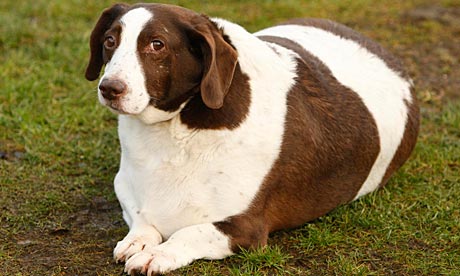
One in Three Dogs 'Too Fat"


SOURCE: THE GUARDIAN, JAMES MEIKLE
Animal organisation says owners are to blame for feeding them scraps and not walking them enough
Patch, a six-year-old, 28kg (4st 6lbs), Beagle cross who is so obese he is unable to walk.
Patch, a six-year-old, 28kg (4st 6lbs), Beagle cross who is so obese he is unable to walk. Photograph: Danny Lawson/PA
Man's best friend is eating too much of his food. Well-intentioned animal-lovers are helping canines mirror the rise in human obesity by giving them their own treats and scraps instead of counting calories, according to an animal welfare group.
More than one in three dogs (35%) are now overweight, according to the veterinary charity PDSA, up from 21% four years ago. If the trend continues nearly half the UK's dogs could be needing to shed pounds by 2013. The statistics come from checks made on 30,000 dogs over that time but numbers of fat cats and obese rabbits are also on the rise, say vets.
Part of the problem is that pet-loving families do not realise how even little amounts of human foods, such as cake, biscuits or cheese, make their animals candidates for Weight Watchers.
"One small plain biscuit for a 10kg dog is the equivalent of us eating a hamburger or chocolate bar", said Sean Wensley, a senior vet with the charity said.
"If you have different family members slipping a bit [of food] here and there, the effects become cumulative."
Owners did not act out of malice, but affection. In most cases, their pets' normal food was offering a nutritionally complete diet. But dogs only need a certain amount of calories in a day.
"Once you start exceeding that calorie requirement, these are not burnt off, get converted into fat and stored, and you start seeing health implications."
As in humans, these include diabetes and heart disease, said Wensley. Other problems in dogs are some cancers, especially bladder cancer, other urinary tract disorders and arthritis. Some breeds such as labradors, basset hounds, and cavalier King Charles spaniels are more prone to obesity.
Lack of proper exercise is another problem, said another of the charity's vets, Elaine Pendlebury. She told the BBC that people underestimated the amount their dogs required. An energetic border collie may need 10 miles of walking a day.
The PDSA says the problem is worst in south-west England, where 39% of dogs are overweight, followed by Scotland and the Midlands with 37%. London has the lowest percentage, 22%.
The charity is offering owners the chance to give their pets what it calls a "new leash of life" by joining its slimming competition and pet "fit club".

Wednesday, June 23, 2010

"Take Your Dog to Work Day" is June 25th!


Dogs put in a real day's work at the office

Published: Wednesday, June 23, 2010, 6:30 AM
SOURCE: WWW.NJ.COM/BUSINESS — Leslie Kwoh/The Star-Ledger
take-your-dog-to-work-dayjpg-c4379dc8c299759f_large.jpg
Courtesy of Pet Sitters International
A company employee poses with her dog on "Take Your Dog to Work Day, " which is taking place June 25 this year.
For starters, the Sayreville business owner is planning to bring her 8-year-old Shih Tzu, whose name is Girl. Another employee is bringing a Yorky, and a third is bringing a Shorky — a mix between a Shih-Tzu and Yorky.Erica Tevis is anticipating a lot more yapping at work this Friday.
The occasion for this fur-fest? The 12th-annual Take Your Dog to Work Day, a word-of-mouth event for canine lovers that has recruited hundreds of businesses across the nation.
The event was first launched in 1999 by Pet Sitters International, an organization with 7,600 members, to raise awareness about pet adoption. While there is no tally on how many businesses participate each year, its popularity has been growing "in leaps and bounds," said spokeswoman Beth Stultz. Last year, the official website saw more than 99,000 unique visitors in the two months leading up to the date.
"It’s a good opportunity to show off your pets," Stultz said. "Co-workers without pets can see that special human-animal bond."
But animal experts say there are a few things to consider if your business is thinking of partaking in the fun this year. Allergies, phobias and dog fights could all turn a lighthearted event into a workplace disaster, said Mychelle Blake, communications director for the Association of Pet Dog Trainers, which is co-sponsoring the event.
"You definitely want to check with everyone first before you bring your dog," Blake said. "Make sure your dog will be comfortable in that environment. If your dog’s a little nervous, bring a blanket or toy it can chew on."
For Tevis and her employees, this Friday will be a rare chance to mix work with some quality pooch time.
When the company participated for the first time last year, Tevis recalls, she and her employees spent much of the day feeding, walking and playing with their dogs.
"We have fun with the dogs. We’re calmer, we’re in a better mood, we pet them," said Tevis, 32. "I wish I could bring my dog in every day."

Thursday, June 17, 2010

Spoiled Dogs Left Millions in Heiress Posner's Will


posnerx-large.jpg
Heiress Gail Posner's dogs are used to living in the lap of luxury, and despite their owner passing away, it seems they won't have to make any adjustments to their lifestyle.
The New York Post reports that Posner has left her $8.3 million Miami mansion and a $3 million trust fund to her beloved three dogs, including one named Conchita. Posner died in March.
Posner's only living son, Carl, a small-time filmmaker, is disputing the will, filing a lawsuit to have it revoked and accusing his mother's aides of drugging her in a conspiracy to gain control over her considerable wealth.
The case is reminiscent of "Queen of Mean" Helmsley, who left $12 million to her Maltese, named Trouble, while ignoring two of her grandkids. A judge later knocked that amount down to $2 million.
Stories about Posner include one about her purchasing a $15,000 Cartier neckless for Conchita but Posner said it didn't meet Conchita's refined tastes, adding "Conchita is the only girl I know who doesn't consider diamonds a girl's best friend.''
SOURCE: USA TODAY, PAW PRINT POST

Monday, June 14, 2010

Dogs need temporary homes - Crime & Courts - SunHerald.com

Dogs need temporary homes - Crime & Courts - SunHerald.com


Dogs need temporary homes

 - rfitzgerald@sunherald.comGULFPORT — The Humane Society of South Mississippi shut its doors to new arrivals Friday because of overcrowding, in part from the plight of 99 dogs seized the night before in an animal cruelty investigation.


The shelter receives an average of 40 animals a day from the public and animal control officers. Thursday, it took in the 99 dogs from Saucier plus 54 other animals.
“I refuse to euthanize animals that are currently in our shelter just to make room for more to come in,” said Tara High, interim executive director.
HSSM made the announcement Friday with a plea for people willing to become “foster parents” for a week or two. Shelter officials want to find temporary housing for the dogs brought in from Saucier to help ease overcrowding.
The dogs are being checked by a veterinarian. HSSM officials want to find 60 to 70 dog lovers who can temporarily care for one of the animals. The dogs can then be put up for adoption or taken elsewhere through the Love Train transport program.
It’s the first time in 58 years the shelter has closed its doors to new arrivals.
The HSSM, which can hold up to 300 dogs, was near capacity before the dogs were seized in Saucier.
Sheriff’s Maj. Tony Sauro said the dogs belonged to Veronica Quinn, 67, who lives with her husband and son. Quinn was cited on 99 counts of animal cruelty. She was not arrested but must appear in court at a later date.
Sauro said the seizure was in response to complaints about the number of dogs and their conditions.
The dogs are medium- to large-sized and represent a variety of breeds. Officials said some have skin or eye infections that are easily treatable. Some are sunburned. One is hairless and covered with scabs and open sores.
Another had just given birth to one puppy and went into distress when officers tried to move her. HSSM officials performed CPR and the dog delivered another eight puppies. One of the pups died. Officials are looking for someone to take the mama dog and her litter until the pups can be weaned.
Officials said foster homes can help save the dogs’ lives until permanent homes can be found.
“It is a short-term commitment that will change a pet’s life forever,” High said. “These dogs deserve a second chance at life.”
Most of the dogs “just need some tender loving care,” said Jode Braxton-Hignight, HSSM director of development.
Twenty-seven kennels were set up in one room Friday and other kennels lined hallways as volunteers and staff members gave the dogs vaccinations and baths and alternated taking them outside for walks. The Sheriff’s Department sent several trusties to help.
Shelter officials also urge animal lovers who are considering adoption to do it now.
The shelter also is asking for donations to help cover medical treatment along with donations of towels, sheets and blankets.


Read more: http://www.sunherald.com/2010/06/11/2253317/dogs-need-temporary-homes.html#ixzz0qq1CCvZ9


SOURCE: SUNHEARLD.COM

Friday, June 11, 2010

Man walks dogs for 2,000 miles -- for a cause - Local News Updates - MetroDesk - The Boston Globe

Man walks dogs for 2,000 miles -- for a cause - Local News Updates - MetroDesk - The Boston Globe


Most people take their dogs for walks around the block or, if the dogs are lucky, a brief romp in the park. Luke Robinson has taken his pups more than 2,000 miles -- for a cause.
In March 2008, Robinson sold his truck and set off on a cross-country ramble with his two dogs, Murphy and Hudson.

The goal? To walk all the way from Austin, Texas, to Boston, telling people along the way about Malcolm, another Great Pyrenees dog that Robinson used to own. Malcolm died of metastatic bone cancer in 2006, and Robinson said he never expected the diagnosis.

"He was my boy," Robinson said. "I never had such a bond with a dog before Malcolm."
So Robinson set off on his epic trek to call attention to canine cancer -- and to do his part to prevent it.

"The most important thing about our mission is really just sharing Malcolm's story and going out and talking to people about canine cancer and comparative oncology," Robinson said. "This is not a race."

Robinson said he's logged over 2,300 miles and it's been "quite a journey."
"We're in North Attleboro right now," Robinson said by phone at about 11 a.m. today. "We're hoping to make it to the Foxboro area today. We're making progress."

Robinson treated himself and his dogs to a hotel room Thursday night, he said.
"It was a long day for us," he said. "They were a little tired, and I decided they needed to be spoiled." The trio will walk on Route 1 or 1A all the way to Boston, Robinson said.
"We'd love to have anybody come out and say hi," he said.

Robinson and his dogs have received help throughout their journey. A California-based dog food company supplied food for the canines, while a Vermont-based company provided them with treats.

Although Robinson brought a tent with them, host families have also given them shelter.
"The great days exceed the tough days," Robinson said. "People have been very gracious and generous."

The trio always insists on being dropped off in the morning where they were picked up at the end of the day, said Ginger Morgan, who met Robinson when he walked through Memphis in 2008 and has been helping him ever since.

"He's walked every step of the way," Morgan said.

When Robinson crossed into Massachusetts Thursday just after 4 p.m., it was the 16th and final state in their journey. Boston is where Robinson lived when Malcolm was diagnosed.

"We're coming home," Robinson said Thursday. "God willing, we'll be there in a week and a day. I can't wait."

On June 19, Robinson will walk his final mile from the Back Bay Fens to Boston Common. More than 100 people from 20 different states plan to join him.

Vendors and rescue groups will be waiting at the Parkman Bandstand in the Common for a celebration. The Canine Hereditary Cancer Consortium will also be on hand to take blood samples from dogs that have had cancer.

"If anyone in the Boston area has a dog with cancer, they should come," Morgan said. "That sample will be used for research and comparative oncology to find better prevention. It will help humans as well."

In the meantime, the trio still has a little more walking to do, Robinson said.
"We've seen a lot of beautiful country," he said. "It's really been an amazing journey."

SOURCE: THE BOSTON GLOBE

Wednesday, May 12, 2010

My Day in the Spotlight By Dubois

A couple of weeks ago, Doggie Couture NY had their first photo shoot. It was the most fun ever! It was my very first professional shoot. From the moment we arrived, I was surrounded by all these new sights and sounds. There was a huge white back drop, huge lights and lots of people around, busy working.

Our photographer, Michael Bloom, brought his two Boston Terriers... Chussie and Maggie. We also had Rat Terriers, Pugs, a Bichon Poo, an Australian Cattle Dog, a Chihuahua and a Schnauzer. My human has never had me in one place with so many different dogs at one time.

We each got our turn in front of the camera and the lights. We all performed our own little poses, sitting pretty, standing up on our hind legs and just looking special! After we each had our turn, our humans let us go out and play ball. It was a blast! Maggie, the smaller Boston Terrier, was a ton of fun! She loved to play chase with me and Bear!

You can check out our photos showing off our new jackets and scarfs on DCNY's website...www.doggiecoutureny.com.

Doggie Couture NY would like to thank Michael Bloom, his assistants and all the dogs and their people for making this a wonderful day!

Tuesday, April 27, 2010

"The Craziest Canine Laws"

This article was passed on to me... I hope you enjoy!

The Craziest Canine Laws

Meet the most ridiculous rules and regulations in all of dogdom!

They say ignorance of the law is no defence and as a person who prides himself as a good, law-abiding citizen and responsible dog owner I felt it necessary to arm myself with as many legal facts relating dogs as I could. Lucky I did. Would you believe how close I came to making funny faces at a dog the last time I visited Oklahoma?

This is, of course, against the law as I'm sure you already knew. Fortunately for you lucky K9 Magazine readers, thanks to my legal delving you too are now free to travel the world safe in the knowledge that you absolutely must not, under any circumstances and no matter how tempting, allow your dog to smoke a cigar in Zion, Illinois or you surely will find yourself in serious hot water. Phew! I'm sure you'll agree, this article is an obvious candidate to be cut out and kept safe. You never know when you might need to refer to it in the future.Ö.

California
In some areas of California, animals are banned from mating publicly within 1,500 feet of a tavern, school, or place of worship.

Ventura Country, California
Cats and dogs are not allowed to mate without a permit.

Hartford, Connecticut
It is illegal to educate dogs.

Northbrook, Illinois
It is illegal for dogs to bark for more than fifteen minutes.

Zion, Illinois
It is illegal for anyone to give lighted cigars to dogs, cats, and other domesticated animals kept as pets. (Cigarettes are perfectly ok we must presume?)

Palding, Ohio
A police officer may bite a dog to quiet him.

Oklahoma
In some areas of Oklahoma: People who make "ugly faces" at dogs may be fined and/or jailed.

Oklahoma
Dogs must have a permit signed by the mayor in order to congregate in groups of three or more on private property. (Quite right too. Why canít our Government act tough to combat the problem of canine hoody gangs congregating outside my local supermarket? Excellent forward thinking legislation.)

North Carolina
Laws applying to some areas of North Carolina prohibit fights between cats and dogs.

Michigan
It is illegal to kill a dog using a decompression chamber.

Fort Thomas, Kentucky
Dogs may not molest cars. (Why can't every country bring this law in? It seems I canít drive anywhere these days without some Labrador lothario or macho Manchester Terrier trying to get intimate with the back end of my Lexus.)

Anchorage, Alaska, United States
No one may tie their pet dog to the roof of a car. (What, not even if they're trying to molest it?)

Belvedere, California, United States 
"No dog shall be in a public place without its master on a leash. (Think about it.)

Denver
The dog catcher must notify dogs of impounding by posting, for three consecutive days, a notice on a tree in the city park and along a public road running through said park. (Now thatís a law that makes total sense. At least if the dogs can read about their likely impounding three days ahead, they can seek alternative accommodation before the worst comes to the worst.)

Illinois
It is illegal to give a dog whiskey (Presumably a Vodka chaser is acceptable though? We donít want to be accused of cruelty here.)

Chicago
It is illegal to take a French poodle to the opera. (Well that's obvious. I thought this was all about crazy dog laws so how did this one creep in?)

-------
The article above comes courtesy of K9 Magazine.
Speaking of which, we've negotiated FREE access to a digital edition of K9 magazine for our luck readers!

Thursday, April 22, 2010

10 TOP PUPPY TRAINING TIPS by The Pet Business Link

10) When trying to settle a puppy into a new home, providing them
with a warm hot water bottle and placing a ticking clock in the
room where they sleep will help to replicate the body heat and
heartbeat of their litter mates and can really help them to relax
in their new environment.


9) When taking your puppy to the Vet for its first inoculations,
health checks etc, it is good practice to sit with your puppy on
your lap and not have him or her on the floor. Apart from being
able to comfort and re-assure the puppy easier in this position
you must also consider the fact that there may be a number of
sick animals in the surgery and your puppy is vulnerable if they
come into direct contact with infectious animals that may also be
in attendance at the same time as your pup. Make a very
deliberate effort to ensure your puppy's trips to the vets are as
fun as you can make them. Don't allow your puppy to think you are
nervous or concerned, instead make a game and even take a toy to
amuse the puppy with whilst they sit on your lap.


8) Always ensure from the earliest possible moment that your
puppy is given his or her own, private sleeping place that is not
used by anyone else in the family or another pet. Your puppy will
benefit from short periods left alone in his or her den with
you always returning to reward the pup when he or she is relaxed
and quiet.


7) Try to make sure your puppy is entertained adequately for
short but regular intervals during the day. Long periods of being
left unstimulated may lead to destructive or disruptive behavior
later in life. Little games playing fetch with the pup's
favorite toy will have the beneficial affect of stimulating the
pup, increasing his or her bond with you and allowing the pup to
expend short, sharp bursts of energy.


6) Don't over-train your puppy. Remember, a one-year old dog is,
effectively, the same as a seven-year old person. It is a good
rule of thumb to keep reminding yourself "would I expect a three,
four, five or six-year old child to accomplish some of the tasks
I am asking of my pup?" Manners, house-cleanliness and the very
basics (including socialization) are all you should really seek
to instill in your puppy until such a time, as they are mature
enough to undergo a more formal training regime. Puppies can
deceive you into thinking they are ready for training but will
ultimately rebel against discipline as they get older. Ensuring
you have taught your puppy to respond to his or her name, what is
and is not acceptable in terms of house-manners and establishing
an uninhibited relationship with your pup is more important than
any other discipline in the early stages of any dog's life.


5) OWWWW! Teach your puppy that biting or nipping is not a
pleasant experience for you by reacting as if in pain to their
playful nips. Rather than scold the dog, let him or her know that
nipping is not a pastime that you wish to engage in. Letting out
an over-exaggerated expression of pain will more than likely
shock the puppy into ceasing this behavior. You will be glad you
put an end to this behavior early on instead of confronting a
playful 2-year-old with a full set of adult teeth!


4) Decide early on what is and is not acceptable in your house.
If you don't want your pup to use the living-room sofa as a
raised dog bed when they get older then donít encourage him or
her to come up for fuss when they're young just because they look
sweetly at you and are small enough to pick up.


3) Jumping up. All puppies love to jump out when greeting anyone.
Rather than reprimand the pup, simply ignore the behavior and
wait until he or she settles down and is not jumping up before
lavishing any attention on them. Above all else, don't encourage
the behavior by patting or praising the dog when they are in the
'jump-position' or you may run in to problems as the dog gets
bigger and views jumping up as an easy way to receive attention.


2) The puppy's name will be with them for life, make sure they
know it by associating it with all things pleasant and fun. In
the same way dog's cotton on in a very positive way to words such
as walks, biscuits or dinner-time they should be given
the same association with their own name. Too often the only time
the puppy hears his or her name is when they have done something
naughty. "Jasper, stop doing that!" "Buster, leave that alone!"
Itís tough but try to ensure that you NEVER use the puppy's name
in a negative scenario only positive ones. Instead of "Jasper,
leave that alone!" simply, "Leave that alone!" or better yet
"No!". And instead of walkies, biscuits or dinner-time try
"Jasper, biscuits!" "Jasper, walkies!", "Jasper, dinner-time!"
Golden rule. Your puppy should associate his or her own name with
all that is pleasant and fun and nothing that is negative. The
word "no" is negative and it is enough to cover all undesirable
behavior.


1) From the moment your puppy comes into your life teach him that
coming to you when called is nothing short of being the best
thing in the world. Puppies can't resist humans who sit down on
the floor with legs spread apart so, while they're easily
persuaded to come by this very simple gesture, make the most of
it by using their name, sparingly, but making a huge fuss when
puppy arrives. Try it at times when pup is pre-occupied with
something interesting and make coming back to you the most
enjoyable and rewarding experience in the world for him or her.
You will really see the benefits as the dog gets older.

Monday, April 05, 2010

The Best Way to Recharge!


After a long week of trying on Doggie Couture's collars and scarfs and posing for the camera, I was feeling a bit exhausted. Modeling and keeping my fabulous image for Doggie Couture is hard work and I really needed to find an outlet. So I decided to discuss how I was feeling with Dr. Wagginstein, my analyst, at my weekly appointment to see if she had any suggestions.
Dr. Wagginstein, a renowned therapist in the canine world, gave me some great advice. She said that even though our main purpose in life is to please our humans, every once in while we need a release. That while I love my human, and my job modeling for Doggie Couture, I should try getting back in touch with my roots and be one with nature so that I can continue to do my job well.

Dr. Wagginstein suggested that over the weekend I look for a way to be one with the earth so that come Monday, I would feel recharged for the week ahead. I decided to take Dr. Wagginstein's advice. After all, she was much older and wiser than my years. Plus, all the humans and other dogs treated her with great respect.

On Sunday, my humans took me and my step-sister, Jett (an Australian Cattle Dog) on a special trip. It was a long car ride, but when I saw where we had arrived, I was elated! It was a beautiful, sunny and warm day! I jumped out of the truck and the smells were just intoxicating! We were on a ranch with lots of horses, cows and other dogs!

My human must have known how I was feeling! She let me run free, and I did! There was so much to explore,  I didn't know how I could fit it all in in just one day. I knew there was no better time than now to follow Dr. Wagginstein's advice. I sniffed and sniffed.... then I found it! It was perfect!... It was pie-shaped and green, and it smelled sooooo good! I dove right in! I rolled and rolled... Dr. Wagginstein was right... I was in heaven!


My human just looked at me with this disgusted, "how could I do that?" face, but she let me keep going. After I finished, I felt so relaxed, back to my roots and one with the earth. This was just the release I needed.

We didn't get home til much later that evening and when we did, I knew I would have to take a bath. But it was so worth it! I am ready for the week ahead. Thanks Dr. Wagginstein!

Friday, April 02, 2010

Come On — Let's Play!


What a Nice Day!
It's so warm out, my human let me go outside without a coat! I love days like these when it finally seems the cold air and white fluffy stuff is not coming back.

Please allow me to introduce myself. My name is Miss Dubois, or at least that is what my humans call me. I originally hail from Dubois, PA, hence the name. I live in upstate New York with my human (other humans call her Anne) and my oversized pack-mate they call "Bear." We can talk about him later.

Now more about me...
I've been told by others that I'm a pretty lucky dog. I go to work everyday with my human, and to be honest, I love it! I have my own cubby and basket where I keep all of my toys. Every morning, a man all dressed in brown, comes to deliver me a cookie. Plus, I get to try on all kinds of nice accessories, and when I pose for the camera, I get even more cookies!

So, you're probably wondering with all these cookies, how do I keep my model figure? Well, first and foremost, let me just say I have good genes! But, I do workout, as you can see from the photo!


Yes, this is what I love about a day like today. Playing outside... All the fresh smells of Spring... Scratching my back on the new grass... And looking oh so fabulous while doing it!